Baklava cheesecake
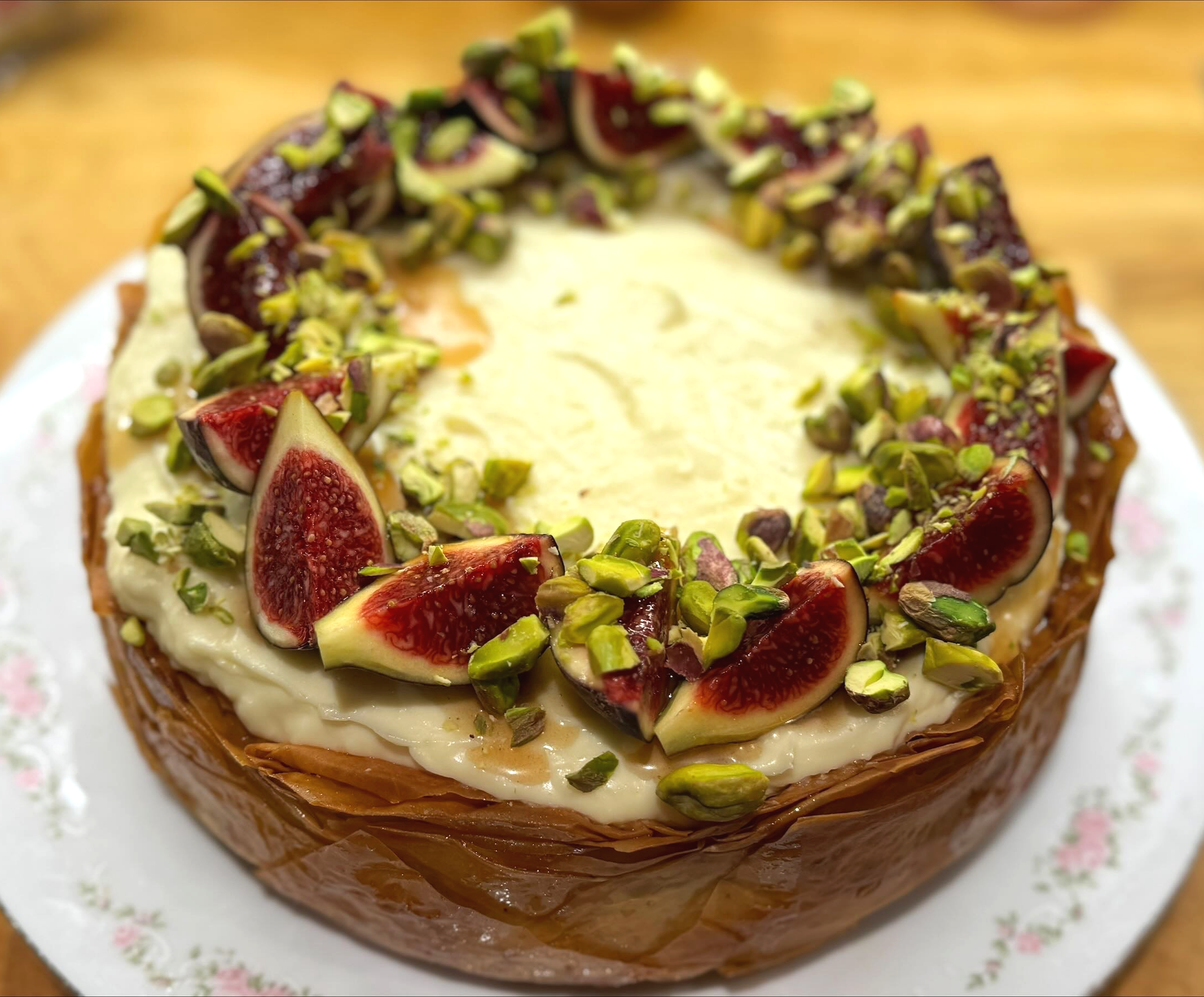
Serves 12
Preparation time: 30 minutes
Cooking time: 55 minutes
Chilling time: 4 hours
Ingredients for syrup
100g caster sugar
100ml water
20g honey
½ tsp ground cinnamon
¼ tsp ground cardamom
2 strips of lemon zest
1 tbsp lemon juice
¼ tsp salt
Ingredients for base
100g pistachios, shelled
75g mix of nuts such as walnuts, hazelnuts, cashews, pecans and almonds
25g caster sugar
125g butter
1 x 270g pack filo pastry
1 tbsp honey
Ingredients for filling
100g caster sugar
200g white chocolate
200g feta
280g full-fat cream cheese
200ml double cream
Ingredients for the topping
50g pistachios, roughly chopped
50g walnuts, roughly chopped
25g caster sugar
About 3 tablespoons honey
Equipment needed
Square cake tin, ideally 20cm
Pastry brush
Food processor
Method
Preheat your oven to 200c.
Start with your base. Place the nuts in a dry frying pan and toast for a few minutes on a medium heat until they start to smell toasty and nutty. Stir in 25g of caster sugar and let it caramelise slightly, then tip the nuts out onto a chopping board and leave to cool a little.
Move on to your syrup. Put all of the syrup ingredients into a small saucepan and bring to the boil, cook on a medium heat high heat for 5-8 minutes, stirring from time to time until thickish and syrupy.
Meanwhile melt the butter. Take the filo out of the packet and cut the sheets in half, you should now have 16 sheets of filo, if have have more, just add an extra layer on the bottom and top. Keep 12 sheets out of the packet and put the others back in the packet. Roughly chop the nuts, making sure they are not too big. I like a bit of variation in size.
Using your melted cinnamon butter and pastry brush, brush the inside of your tin, sides and base.
To start assembling, take your first sheet of filo and brush it all over with butter, being sure to butter all the way to the edges. Put the sheet of filo into your tin, butter side up, pushing the sheet over the bottom and up the sides, overlapping the sheets to ensure the side is all covered. Sprinkle a third of your nuts over the top of the buttered filo sheets and drizzle 1 tsp of honey over the top.
Repeat this twice more, filo, nuts, honey until all of the nuts are used up. Finish with the remaining sheets of filo. Gently push down to compress the filo and nuts. A note here, the butter may start to solidify, if it does, just gently reheat until it melts again.
Tuck any pastry that is overhanging the tin in at the top, otherwise it will shatter when you release the springform tin. Bake in the oven for 25-30 minutes, until crisp and golden.
Break up the white chocolate into a bowl that can go into a microwave and melt on 30 second bursts, stirring between each blast, stopping when only a few lumps remain. Stir until smooth. Leave to cool.
When the filo shell is ready, remove from the oven and drizzle all but 3 tbsps of the syrup all over the pastry, particularly down the sides. Leave to cool a touch.
For the cheesecake mix, using a food processor, blitz the feta and sugar keep processing until it's smooth, around 3 minutes. Add in the cream cheese and process until it's smooth and combined. Add the double cream, blend again until light.
Very carefully remove the case from the tin and put onto a serving plate. Be very careful because the shell is very fragile. Put into the fridge for 10 minutes so that the case can cool enough for the filling.
Finally stir through the now cooled melted white chocolate with the cheesecake mix.
Spoon the filling into the filo case, loosely cover and chill in the fridge for at least 4 hours, or overnight if possible.
Just before serving, put the nuts in a dry frying pan and toast for a few minutes on a medium heat until they start to smell toasty and nutty. Sprinkle over the caster sugar and shake the pan and cook until caramelised.
To finish the cheesecake, cut the fresh figs into different sizes (roughly 4 or 6), then place around the edge of the cheesecake. Finish with the caramelised nuts, a drizzle of the remaining syrup and a little sprinkle of salt.
- An adaptation of a recipe is by Georgina Hayden and taken from Greekish