My 12 Favourite Ingredients: Chillies

Welcome back to my 12 favourite ingredients and my next pick is chillies. Originally I was going to pick chipotle specifically as that is probably my absolute favourite, but I also love ancho. And, where would we be without peri peri chillies? We would not be able to make peri peri sauce and enjoy prego's. Or birds eye chillies because then we would not be able to make an authentic Thai curry (which we LOVE). So the more I thought of it, the more I realised I could not pin it down.
Chillies are something we always have a variety of in our fridge and in the cupboards. They say a picture is worth a thousand words and I have to be honest, even I was surprised at just how many chillies we have (fresh, dried and powder form) we had when I was taking the photos. I love the different flavours they bring, the different heat, there is such a great variety of chillies and honestly, not all of them are spicy. I like to put smoky chillies into long slow cooks and fresh over wings, noodles, rice dishes or creamy dishes to just give that little kick.
Did you know there are over 4,000 varieties of chillies. Chillies contain a compound called capsaicin which triggers endorphins by binding to pain receptors in the mouth, tricking the brain into thinking that your mouth is burning. Endorphins act as natural painkillers and produce a feeling of well-being and pleasure. Chillies are full of vitamins A and C and are also said to clear congestion, act as an antioxidant, boost metabolism, reduce pain and inflammation and improve heart health by reducing blood pressure and cholesterol levels.
Many good reasons to start eating chillies. You will find the more you eat spicy food, the more you build up a tolerance for chilli heat. The seeds and membrane inside the chillies are much hotter than the flesh of the fruit so simply remove them if you want less heat.
Chillies are measured in SHU (Scoville Heat Units) which measures the concentration of the capsaicin. The SHU shows how many times the extract from a chilli needs to be diluted before it the heat is no longer detectable. Different chillies have different SHU’s, some are extremely mild measuring from 0 to around 2,000 on the Scoville chart (think red and green peppers or a poblano pepper) and some are extremely hot and measure over 1 million on the Scoville chart (think ghost pepper and the Carolina Reaper).
For a long time the Carolina Reaper was as hot as it got, coming in at 1,400,000 to 2,200,000 SHU(!) however, in September 2023 Pepper X took the top spot with the SHU coming in at a whopping 2,630,000 to 3,180,000. The SHU can be affected by soil and climate, hence the variable. Eating one of these chillies raw would cause extreme pain. For those of you wondering where England sits on this scale, in 2021 the Dragons Breath was created and although never officially tested, this has an unofficial SHU of 2,480,000.
Now I like chillies, we both do, but extreme chillies are not for me, I love the taste, love the zing but don’t want it to make food so hot I cannot enjoy it. My suggestion for using chillies is to gage just how spicy they are before you put them into your food. To check, cut a tiny amount off of the chilli you are using and taste it, see how hot it is and then decide how much you want to use. Don’t forget, the seeds and the membrane are much hotter so if the chilli is almost at your limit, or if you are happy, remove the seeds and membrane before adding. Oh and a word of caution, never, ever, ever touch sensitive areas with chilli hands. If you accidentally touch your face for instance your skin may well go bright red and be very uncomfortable for some time and it really hurts if you touch your eyes and they will stream for some time. Wear gloves if you can or make sure as soon as you have cut chillies, you wash your hands well and still be cautious when touching your eyes and face, you will be amazed at how long it takes to get off of your hands.
There is a dish we cook, spicy chicken noodles that actually highlights how potent chillies can be. You start the recipe putting dried long chillies (Chinese) into hot oil then after heating them in the oil for a short time, you discard the chillies, their sole purpose is to flavour the oil. In my recipe I say throw open your windows - you need to make sure you do that because you will be coughing and spluttering and your eyes will stream otherwise.
So, let’s deep dive a little into different types of chillies. There are fresh, dried whole and dried powder.
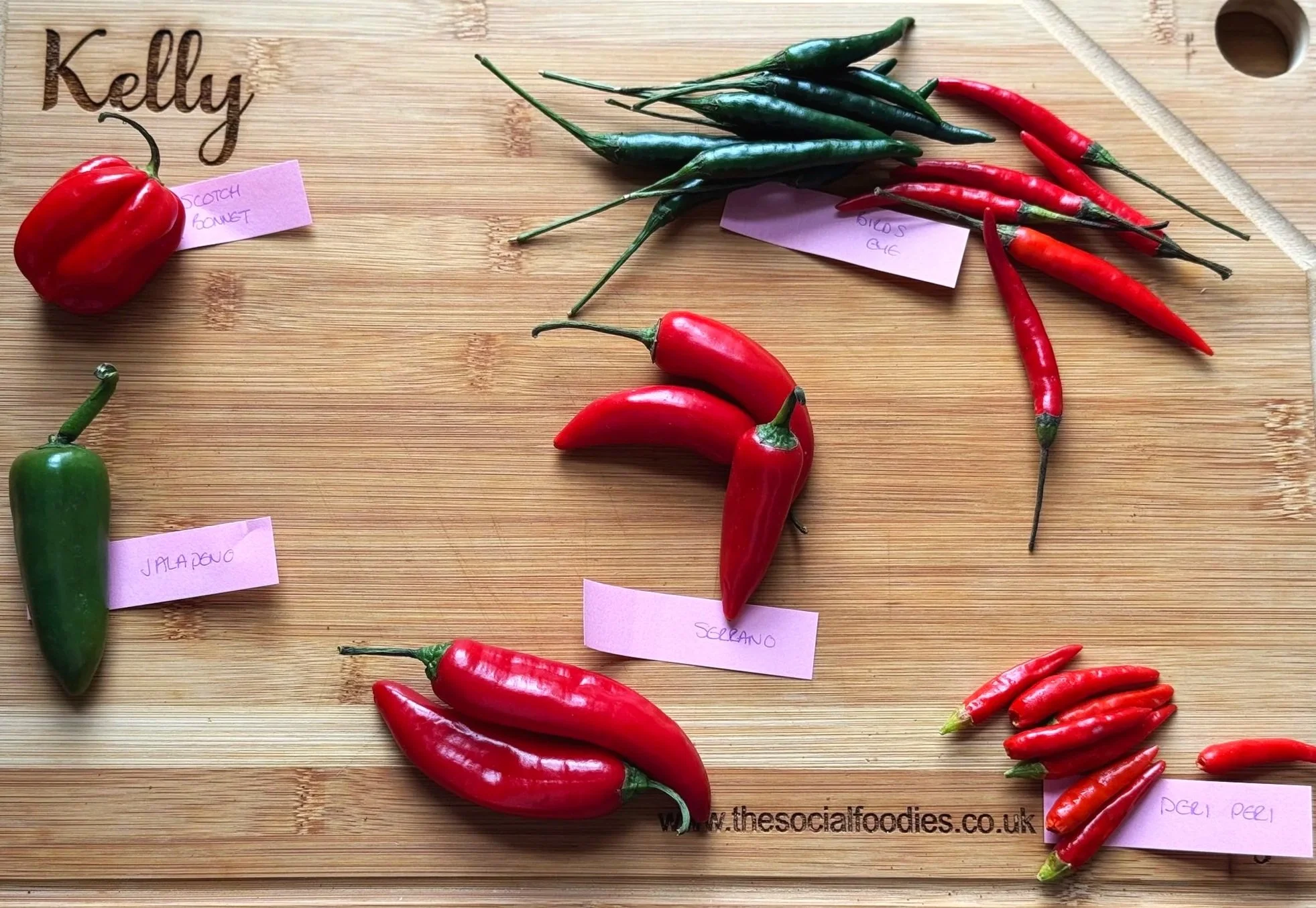
Starting with the fresh chillies, going from the top left clockwise around my board, we have:
Scotch Bonnet
Despite being very hot chillies (for me), measuring between 100,000 and 350,000 SHU, the scotch bonnet chilli has a very fruity, tropical flavour and is used widely in Caribbean cooking. For recipes that use scotch bonnet, start slowly unless you know you have a high chilli tolerance. I start with half a chilli and increase, you can always add but once there is too much chilli in a dish it is very difficult to correct that for your tastes. Try our Jamaican inspired beef patties.
Birds eye
Birds eye chillies are going down the Scoville scale a touch, measuring 50,000 to 100,000 SHU. Birds eye chillies are predominately used in Thai cooking, both in sauces and dishes and scattered fresh over the top. Dried these are sold as long red chillies. Try our Thai green curry.
Peri Peri
Peri-peri (or piri-piri) chillies are small, fiery little things which are known for their intense heat and distinct bright, citrussy herbal flavour. Their SHU is 50,000 to 175,000 and they are largely used in African and Portuguese cooking. They are used in this house to make peri peri sauce (think Nando’s!) by the bucket load for all our friends. We pair the sauce with peppadews which give a distinct African flavour. This is one of our absolute favourite sauces.
Serrano
Serrano chillies largely make up the ‘mixed chillies’ you buy in supermarkets. Originating in Mexico these little babies can be fairly mild and then every now and again you will get one that is so hot you just are unsure where it came from (it is likely a different variety as there are a couple of chillies that look very similar). They have an SHU of 10,000 to 25,000 so considered fairly mild. These for us are your ‘everyday’ chilli. I remember once buying a packet and we had used maybe 4 of the 5 in the packet, none had any heat at all. Now generally before using chillies we would cut a little off, taste it to see how hot it is and that will determine just how much we use, or indeed if we think the seeds and membrane must go. However on this fateful day we had become complacent with this packet and did not test this chilli, we cut it up and put it all over the top of a Pho I had been lovingly cooking for hours. The pho was gorgeous but the chilli was so hot I cannot begin to tell you, 1 rogue chilli in a bag. It caught us totally off-guard. Learn from us, always taste. These chillies are staples of Mexican cuisine. We use these in many dishes including pasta dishes such as this crab and courgette spaghetti or puttanesca.
Jalapeño
Jalapeño chillies are one of my favourites, they are medium on the heat scale and really full of flavour. They are great stuffed with cheese and made into poppers or made into Jalapeño jelly which works perfectly with cold meats and cheese, or cowboy candy. Much like the Serrano they vary a little, with their SHU being 4,000 to 8,500. These are also staples in Mexican and Tex Mex cuisine. Dried and smoked they become chipotle chillies. Try our jalapeño and cheddar cornbread.
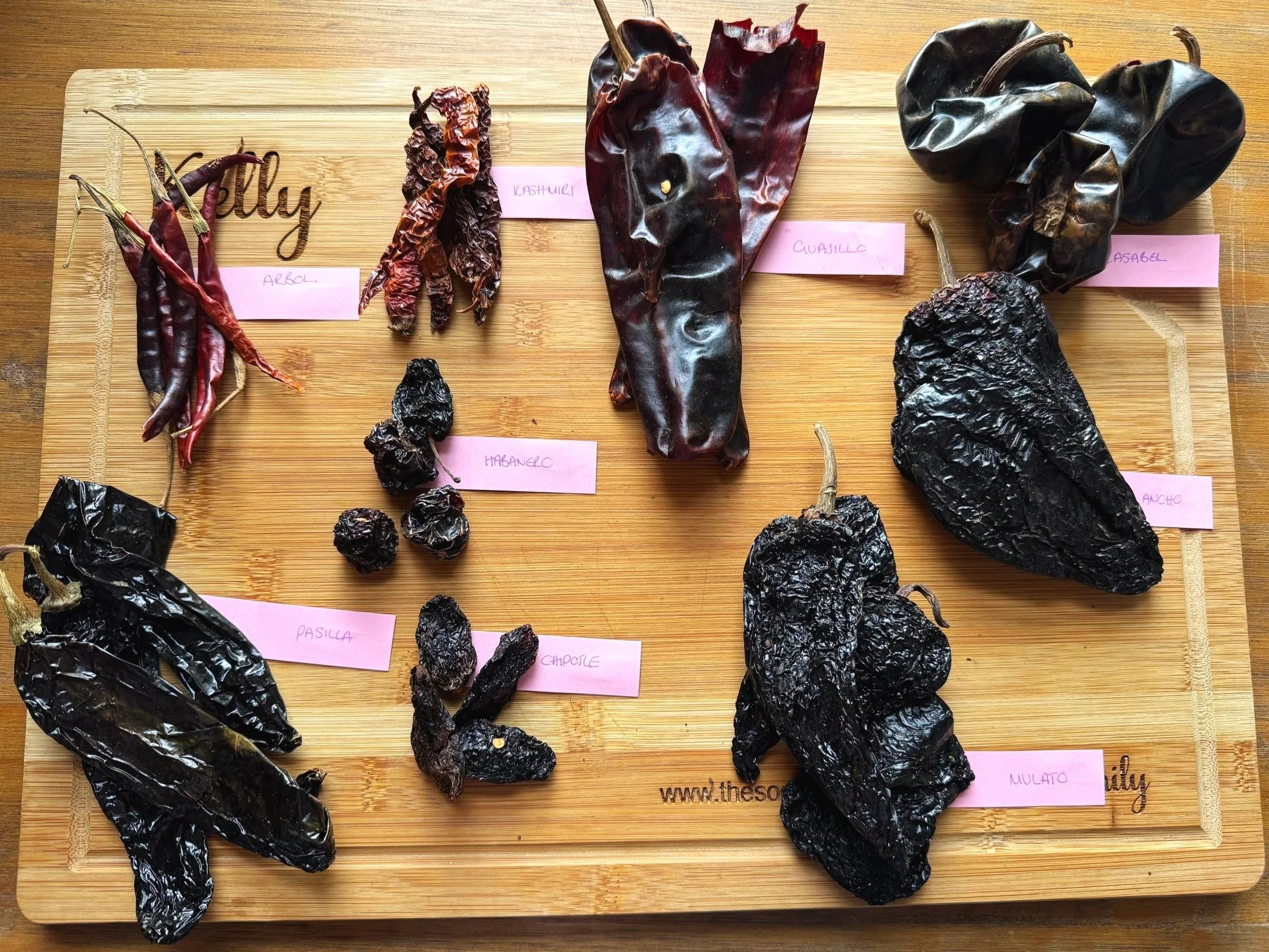
Moving on to our dried chilli board, these are whole and I usually put them into whatever I am cooking whole and leave them in while the dish cooks and then when finished, I carefully squeeze them when I remove them. Dried chillies are said to be hotter than fresh so remember, you can always add more but correcting too much is difficult. Again going from the top left clockwise. We have:
Arbol
This small chilli, popular in Guadalajara packs a punch. Coming in at 15,000 to 30,000 SHU they are popular in broths and sauces and are known for their intense, acidic and nutty notes.
Kashmiri
Kashmiri chillies are generally considered to be mild, with a general SHU of between 1,000 and 2,000. They are used primarily to give colour to dishes with their vibrant deep red hue. They give a very subtle and gentle chilli note. These are generally used in Indian cooking. Look at the kashmiri lamb rogan josh.
Guajillo
The guajillo chilli is very popular, in fact, in Mexican cuisine this is the second most popular chilli (coming in after the ancho). They have a bright, tangy flavour and are considered to be mild, only coming in at 2,500 to 5,000 SHU. Often used in the Mexican mole dish they have a complex rich flavour. We have actually put these in our Harissa paste, perhaps not very authentic but it works for us.
Casabel
Casabel chillies are so named because of the sound they make. They sort of have a look of maracas and, if you shake them, they sound very similar too. Coming in at 1,000 to 3,000 SHU they give a nutty, earthy, slightly smoky flavour. They work well in long braises and sauces.
Ancho
The ancho chilli is a dried young poblano pepper and they are one of my favourite chillies, I love the smokiness of them and I love how well they work in both sweet and savoury dishes. Their heat is mild, coming in at between 1,000 and 2,000. They have a sweet chocolatey taste with notes of coffee. Try adding a tsp of dried powder in your favourite brownie recipe, it really does add a very nice flavour and because they are not hot, you are unlikely to realise there is chilli in it. Ancho, as one of the milder Mexican chillies, has a mellow fruitiness that lends itself well to pairing with other fragrant flavours, such as lime. I use these in chilli con carne, easy dry rub ribs, coffee steaks, my favourite however is beef short ribs with polenta, this looks long but is actually mostly hands off.
Mulano
The older sibling of the ancho. This is also a dried poblano pepper that has been left on the vine to fully mature to a dark brown/red colour. This chilli is used in Mexican mole dishes which is enhanced by the smoky chocolatey liquorice fruity notes. Measuring slightly more SHU this comes in at 2,500 to 3,000.
Chipotle
Now for my absolute favourite chilli hands down. There are two jalapeño varieties that make the chipotle which might account for the SHU discrepancy. Said to be 2,500 to 8,000 it has been reported that they have been reported at coming in just over 10,000. Whatever the heat, for me this is a nice heat, you know you are eating chilli, it is so flavourful and yet it doesn’t blow your socks off. They have a sweet smoky earthy flavour and perfect in so many dishes. Whenever I want a smoky back-heat this is most definitely the chilli I reach for. I have this in both dried and powder form. Used in both Mexican and Tex Mex cuisine. You will find this in our tomato soup or sweetcorn soup, a spicy mayo, a chicken burger, a beef burger, spicy bbq sauce and of course our chilli non carne - to name just a few.
Pasilla
The Pasilla chilli is also a mild pepper with the SHU typically ranging from 1,000 to 2,500. Known for its dark, wrinkled appearance the Pasilla (meaning "little raisin"), offers rich, earthy, and slightly fruity notes. Also used in Mexican moles.
Habanero
These small dried little chillies are known for their heat and smoky, fruity citrussy flavour. Habanero is the hottest chilli grown in Latin America. They may be small but they are mighty, with their SHU ranging from 100,000 to 350,000. Fresh the habanero add a fiery kick to salsas and marinades and dried they work in sauces and slow braises. They work well with tropical fruits. Used widely in Brazilian cuisine you will definitely know your dish has chilli in it. Look at our pollo asado.
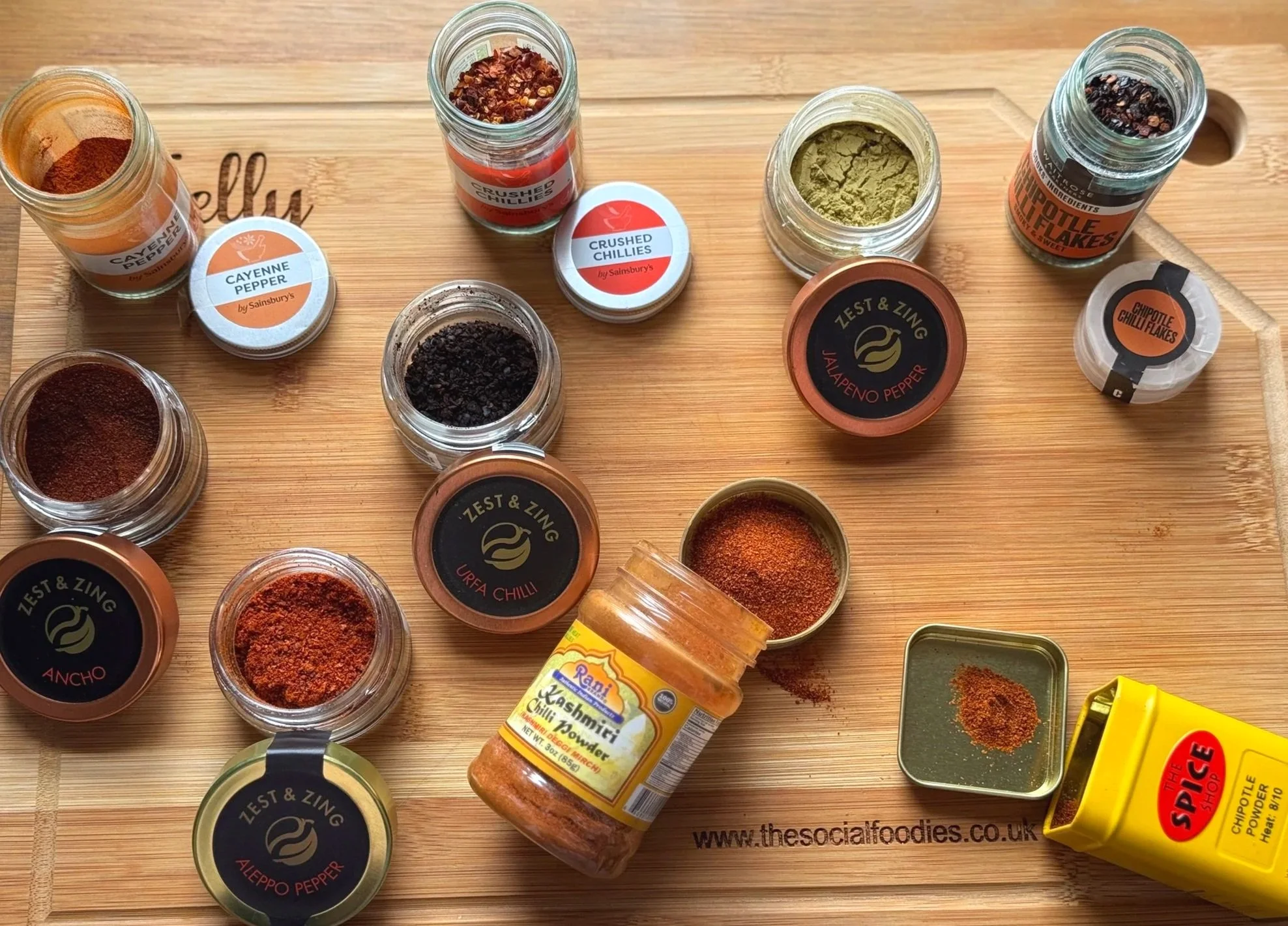
And so to our final board, the dried chilli powder, again working left to right clockwise.
Cayenne
Of all the chillies have, the cayenne has always been my least favourite. For me, it has a very sharp lingering heat with no rounded flavour most chillies give. This is a fairly hot chilli, fiery and bright red and comes in at 30,000–50,000 SHU. This chilli was named after the Cayenne region in French Guiana, South America. This powder is used in Cajun, Indian and Korean dishes. I advise caution, start with a small amount - perhaps a pinch or ¼ tsp and taste before adding more.
Crushed chillies
Crushed chillies are much like the mixed chilli packets you find in supermarkets, generic and they can be made up of anything, they are just dried crushed chillies that include the seeds and membranes. Because of the generic nature you may find that some brands are much hotter (or indeed milder) than others. My suggestion therefore is to find a brand you like and stick to that. Assume however this is a medium heat and that ½ tsp equates to 1 chilli.
Jalapeño
As detailed above in the fresh section, although I find dried tends to be hotter than fresh, the longer the powder is stored, the more it loses some of its flavour and heat.
Chipotle flakes and powder
As detailed above in the dried whole section. Again this loses its flavour and heat the longer it is kept, and it loses it faster than the whole dried chilli.
Kashmiri
As detailed above in the dried whole section. Again this loses its flavour and heat the longer it is kept, and it loses it faster than the whole dried chilli.
Urfa
Also known as Turkish pepper flakes, this is heavily used in Turkish cuisine. This chilli has a smoky, earthy flavour with notes of dried fruit, coffee, chocolate and tobacco. This chilli ranges between 7,500 and 50,000 SHU. With such a huge differential in heat, find a brand you like and stick to it.
Aleppo
Originally hailing from Syria, Aleppo pepper is also known as Pul Biber and is an essential spice for Middle Eastern and Mediterranean cuisine. The complex flavour profile is said to have notes of raisins, sun dried tomatoes and cumin and is often used as a finishing spice on dishes. Both the seeds and membranes are removed before crushing, the heat is reduced somewhat, this comes in at around 10,000 SHU, which is considered to be of a moderate heat. Look at our baba ganoush recipe.
Ancho
As detailed above in the dried whole section. Again this loses its flavour and heat the longer it is kept, and it loses it faster than the whole dried chilli.
I hope you have enjoyed learning all about chillies. With so many chillies they all have different flavours and uses, try some of our recipes and let us know your favourite.